Normal range: Above 4000 cells/µL (higher is better)
The white blood cell count measures how many infection-fighting immune cells are circulating in your blood. White cells are your body's defense system against bacteria, viruses, and other invaders. A high count usually signals that your body is fighting an infection or responding to inflammation, stress, or tissue damage. A low count can mean your immune defenses are weakened, leaving you more vulnerable to infection. WBC is always read alongside the differential, which breaks the total into its five cell types.
A normal WBC is Above 4000 cells/µL. Higher is better.
High white blood cell counts most often reflect an active infection, as the body ramps up immune cells to fight off bacteria or viruses. Inflammation, physical or emotional stress, smoking, and recent intense exercise can all push the count up temporarily. Corticosteroid medications raise it as well. Persistently high counts can point to chronic inflammation or, rarely, a bone marrow disorder.
Low white blood cell counts can result from viral infections, autoimmune conditions, vitamin B12 or folate deficiency, and some medications. Bone marrow problems and an enlarged spleen can also lower the count.
A single mildly abnormal reading is often transient and worth rechecking. Not smoking, managing stress, getting adequate sleep, and treating underlying infections help keep the count in a healthy range. Because the total reflects the sum of five different cell types, the differential is what reveals which part of the immune system is reacting.
White blood cells help fight infection and are part of the immune system. Elevated levels may indicate infection or inflammation.
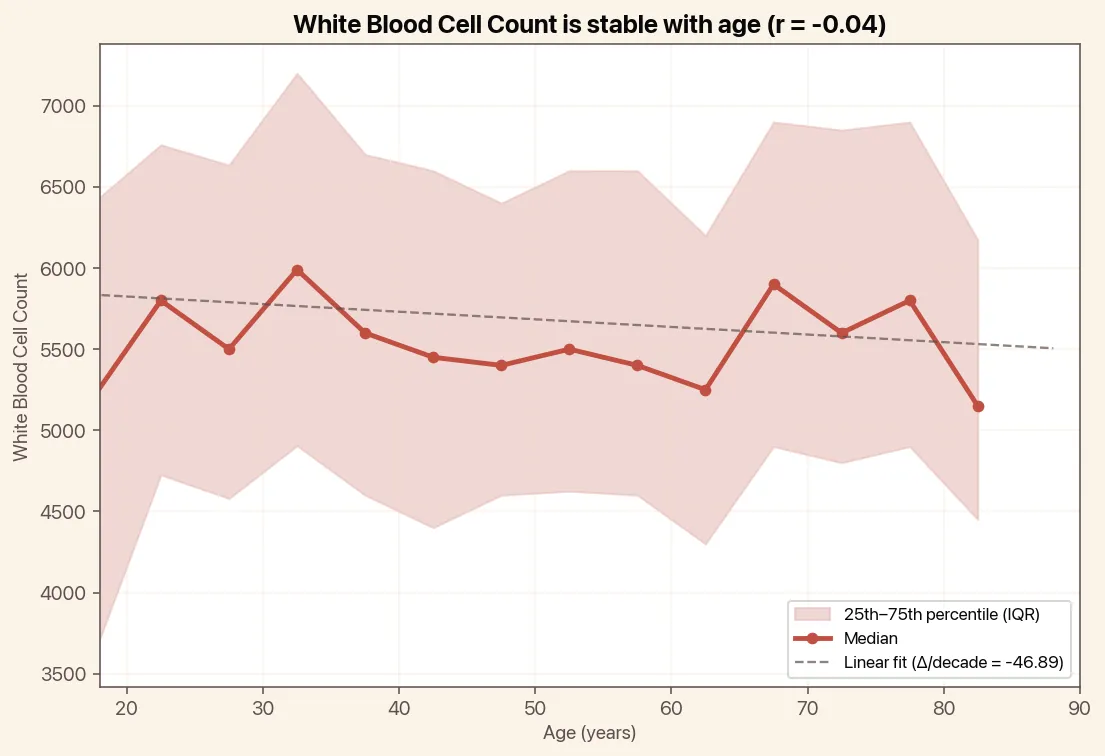
White Blood Cell Count stays relatively flat across adult ages (correlation with age, r = -0.04). Most of the spread in the chart below comes from differences between people rather than from age.

WBC is most highly correlated with Absolute Monocytes and Absolute Neutrophils. Here are the top biomarkers correlated with WBC, based on 500,000 tests done by Empirical Health.
The percentage shows how strongly two biomarkers move together. A higher number means the relationship is stronger. Green = rises and falls together. Orange = one rises as the other falls.
At Quest or LabCorp, WBC comes in a complete blood count (CBC) for about $29–$45. It's also included in a 100+ biomarker panel from Empirical Health for $190.
You can measure your WBC for at 2,200+ testing locations across the US. Click below and enter your zip code to browse locations near you.
Test your White Blood Cell Count and 100+ other biomarkers in a single blood draw.