Test your Platelets and 100+ other biomarkers for $190

Platelet Count

Normal range: Above 150000 cells/µL (higher is better)

Platelets are tiny cell fragments that clump together at injury sites to form clots and stop bleeding. Low platelets (thrombocytopenia) increase bleeding risk, showing up as easy bruising or prolonged bleeding from cuts. High platelets (thrombocytosis) can increase clotting risk and may indicate infection, inflammation, or a bone marrow disorder. A single abnormal reading is common and often resolves on its own.

Test your Platelets

How much does a Platelets test cost?

Platelets isn't sold on its own. It comes in a complete blood count (CBC), about $35. A fuller workup adds Vitamin D ($75), hs-CRP ($69), ApoB ($50), and ApoA1 ($50). You can test Platelets and 100 other biomarkers for $190 as part of an Empirical membership.

Empirical is FSA/HSA eligible, so you can pay with pre-tax dollars. Fast for 8-12 hours beforehand for the most accurate lipid and metabolic results, and expect results in days rather than weeks.

Get tested for $190

Platelet count measures the number of platelets in the blood, which are essential for clotting and wound healing.

How does Platelet Count change with age?

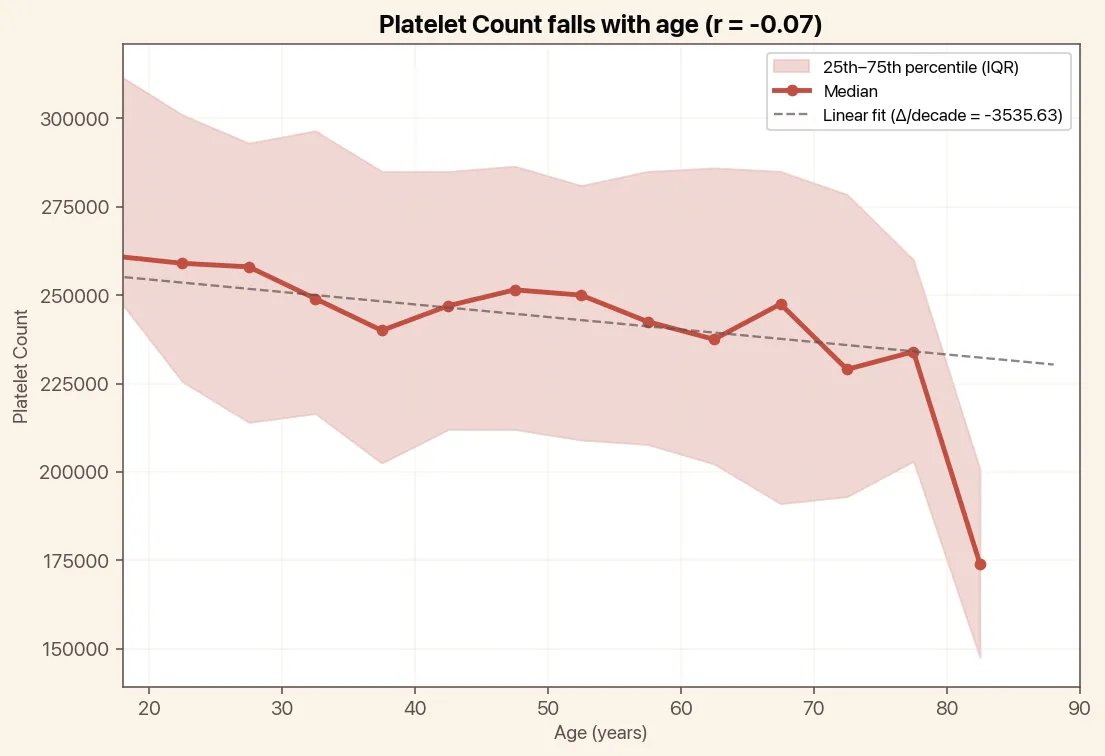
Platelet Count tends to fall with age (correlation with age, r = -0.07). The chart below shows the median by 5-year age bin and a linear trend line.

Platelet Count falls with age, chart with median and linear trend

What can cause low Platelets?

A normal Platelets is Above 150000 cells/µL. Higher is better.

Low platelet count can result from viral infections (including COVID-19), autoimmune conditions like ITP (immune thrombocytopenic purpura), liver cirrhosis, heavy alcohol use, or bone marrow suppression from medications or chemotherapy. Heparin is a well-known cause of immune-mediated platelet destruction. Other medications that can lower platelets include certain antibiotics, anticonvulsants, and quinine.

High platelets are often a temporary, reactive response to infection, inflammation, iron deficiency, or surgery. Chronic elevation without an obvious trigger may indicate a myeloproliferative disorder like essential thrombocythemia.

There are no specific dietary changes that raise or lower platelets. Moderating alcohol intake helps prevent alcohol-related platelet suppression. If you have chronically low platelets, your doctor may recommend avoiding NSAIDs and blood thinners that increase bleeding risk.

Biomarkers related to Platelets

Platelets is most highly correlated with Absolute Monocytes and Absolute Neutrophils. Here are the top biomarkers correlated with Platelets, based on 500,000 tests done by Empirical Health.

The percentage shows how strongly two biomarkers move together. A higher number means the relationship is stronger. Green = rises and falls together. Orange = one rises as the other falls.

Frequently asked questions about Platelets

Where to get a Platelets test near you

Platelets is drawn at 2,200+ Quest and BioReference patient service centers across the US, so there's usually one within a short drive. Browse the full directory to find the one closest to you.

Browse all testing locations

Know your Platelets. Know your health.

Test your Platelet Count and 100+ other biomarkers in a single blood draw.

Image of a man on cellphone
Start testing