Thyroid Stimulating Hormone (TSH) regulates thyroid function and metabolism.
How does TSH change with age?
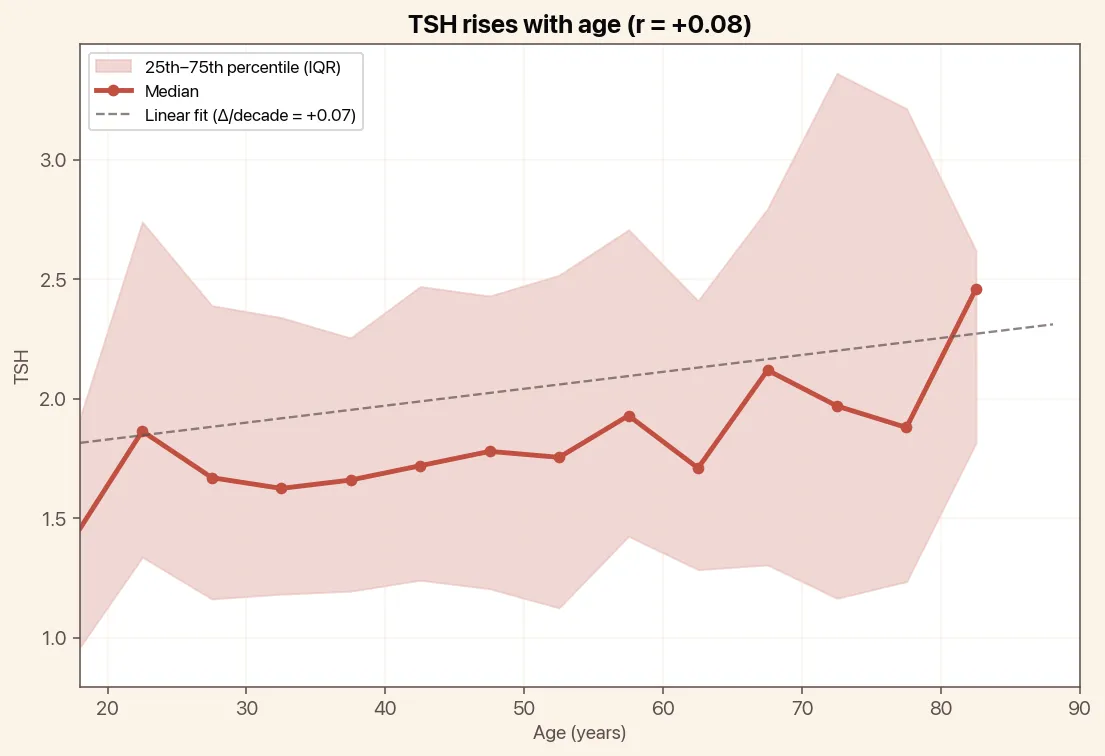
TSH tends to rise with age (correlation with age, r = +0.08). The chart below shows the median by 5-year age bin and a linear trend line.
Normal range: 0.4 – 4 mIU/L (higher is better)
TSH is a hormone released by the pituitary gland that tells your thyroid how much T3 and T4 to produce. It is the most sensitive screening test for thyroid problems. The relationship is inverse: high TSH means your thyroid is underactive (hypothyroidism), and low TSH means it is overactive (hyperthyroidism). Thyroid hormones regulate metabolism, energy, weight, heart rate, body temperature, and mood, which is why thyroid disorders affect so many different systems.
On its own, TSH costs about $45 but is usually measured in a panel alongside Vitamin D ($75), Vitamin B12 ($45), hs-CRP ($69), and ApoB ($50). You can test TSH and 100 other biomarkers for $190 as part of an Empirical membership.
Empirical is FSA/HSA eligible, so you can pay with pre-tax dollars. Fast for 8-12 hours beforehand for the most accurate lipid and metabolic results, and expect results in days rather than weeks.
Thyroid Stimulating Hormone (TSH) regulates thyroid function and metabolism.
TSH tends to rise with age (correlation with age, r = +0.08). The chart below shows the median by 5-year age bin and a linear trend line.
A normal TSH is 0.4 – 4 mIU/L. Higher is better.
High TSH indicates the thyroid is underperforming and the pituitary is compensating by sending more signal. Hashimoto's thyroiditis (an autoimmune attack on the thyroid) is the most common cause. Iodine deficiency, thyroid surgery, and radiation therapy are other causes. Symptoms include fatigue, weight gain, cold intolerance, dry skin, and depression.
Low TSH means the thyroid is overactive. Graves' disease (autoimmune hyperthyroidism) is the most common cause, followed by toxic nodular goiter and thyroiditis. Symptoms include weight loss, anxiety, rapid heart rate, tremor, and heat intolerance.
Several medications affect TSH. Levothyroxine (thyroid replacement) is the most common, but biotin supplements can falsely lower TSH readings on some lab assays. Lithium and amiodarone can cause either hypothyroidism or hyperthyroidism. Corticosteroids and dopamine can suppress TSH temporarily. Thyroid function is not strongly influenced by lifestyle, but adequate iodine intake (from iodized salt, dairy, and seafood) is essential for normal thyroid hormone production.
TSH is most highly correlated with Estimated Glomerular Filtration Rate and BUN. Here are the top biomarkers correlated with TSH, based on 500,000 tests done by Empirical Health.
The percentage shows how strongly two biomarkers move together. A higher number means the relationship is stronger. Green = rises and falls together. Orange = one rises as the other falls.
TSH is drawn at 2,200+ Quest and BioReference patient service centers across the US, so there's usually one within a short drive. Browse the full directory to find the one closest to you.
Test your Thyroid Stimulating Hormone and 100+ other biomarkers in a single blood draw.