Normal range: 2 – 3.5 g/dL (higher is better)
A globulin blood test measures a group of proteins that includes your immune antibodies and transport proteins. Think of globulins as your immune system's protein signature. When your body is fighting infection or dealing with chronic inflammation, globulin levels tend to rise. When your immune system is weakened, they drop. Globulin is most useful when read alongside albumin.
Globulin isn't sold on its own. It comes in a comprehensive metabolic panel, about $40. A fuller workup adds Vitamin D ($75), hs-CRP ($69), ApoB ($50), and ApoA1 ($50). You can test Globulin and 100 other biomarkers for $190 as part of an Empirical membership.
Empirical is FSA/HSA eligible, so you can pay with pre-tax dollars. Fast for 8-12 hours beforehand for the most accurate lipid and metabolic results, and expect results in days rather than weeks.
Globulin is a group of proteins that includes your immune antibodies and transport proteins. Think of globulins as your immune system’s protein signature. When your body is fighting infection or dealing with chronic inflammation, globulin levels tend to rise. Globulin is most useful when read alongside albumin.
Globulin stays relatively flat across adult ages (correlation with age, r = -0.01). Most of the spread in the chart below comes from differences between people rather than from age.
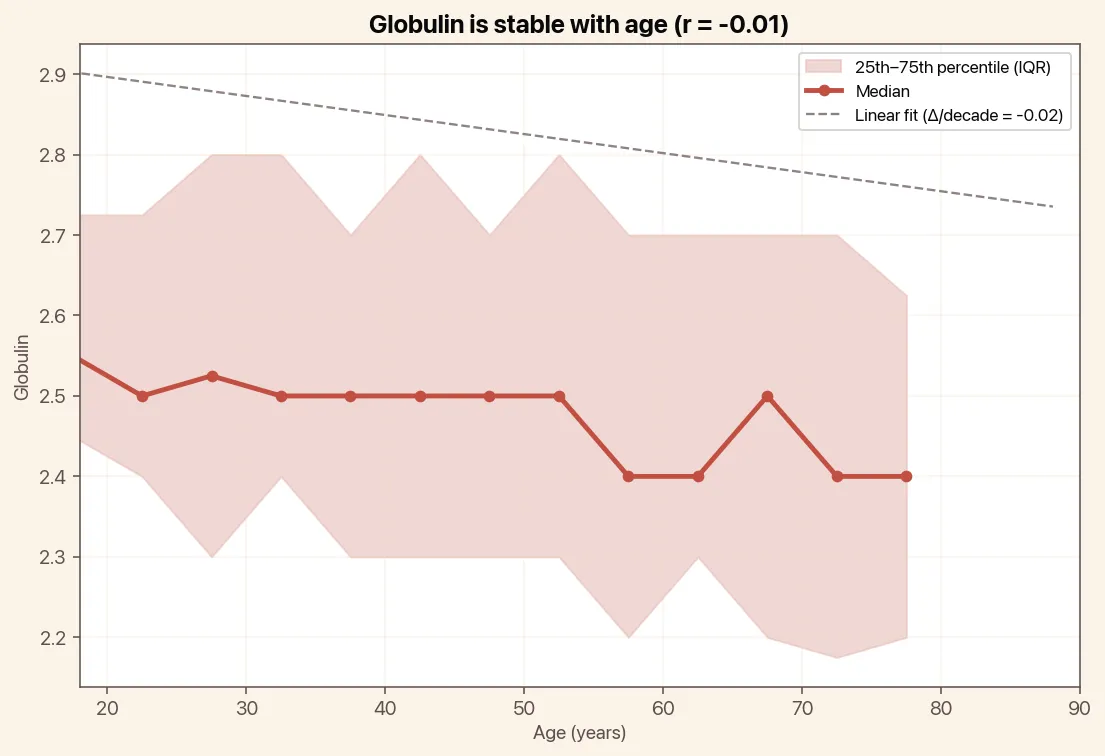

A normal Globulin is 2 – 3.5 g/dL. Higher is better.
High globulin is more common than low. Chronic infections (hepatitis, HIV), autoimmune conditions (lupus, rheumatoid arthritis), and plasma cell disorders (multiple myeloma) are the main causes. Even mild chronic inflammation can nudge globulin upward over time.
Low globulin may indicate an immune deficiency, impaired antibody production, or protein loss through the kidneys. Corticosteroids and immunosuppressant medications can lower globulin by dampening immune activity. Malnutrition and liver disease reduce production as well.
Lifestyle changes that reduce chronic inflammation, such as regular exercise, a balanced diet, and maintaining a healthy weight, can help normalize elevated globulin. If globulin is low, working with your doctor to identify and treat the underlying cause is the best approach.
Globulin is most highly correlated with Total Protein and Albumin. Here are the top biomarkers correlated with Globulin, based on 500,000 tests done by Empirical Health.
The percentage shows how strongly two biomarkers move together. A higher number means the relationship is stronger. Green = rises and falls together. Orange = one rises as the other falls.
Globulin is drawn at 2,200+ Quest and BioReference patient service centers across the US, so there's usually one within a short drive. Browse the full directory to find the one closest to you.
Test your Globulin and 100+ other biomarkers in a single blood draw.