Test your RDW and 100+ other biomarkers for $190

Red Cell Distribution Width

Normal range: 11.5 – 14.5 % (lower is better)

RDW measures how much variation there is in the size of your red blood cells. A high RDW means your red cells range from small to large rather than being uniform, which happens when your body is producing abnormal cells or transitioning between two states (like recovering from a deficiency). Interestingly, elevated RDW has emerged as an independent predictor of cardiovascular risk and all-cause mortality, even in people without anemia.

Test your RDW

How much does an RDW test cost?

RDW isn't sold on its own. It comes in a complete blood count (CBC), about $35. A fuller workup adds Vitamin D ($75), hs-CRP ($69), ApoB ($50), and ApoA1 ($50). You can test RDW and 100 other biomarkers for $190 as part of an Empirical membership.

Empirical is FSA/HSA eligible, so you can pay with pre-tax dollars. Fast for 8-12 hours beforehand for the most accurate lipid and metabolic results, and expect results in days rather than weeks.

Get tested for $190

RDW reflects the variation in red blood cell size, which can help identify types of anemia and other conditions.

How does Red Cell Distribution Width change with age?

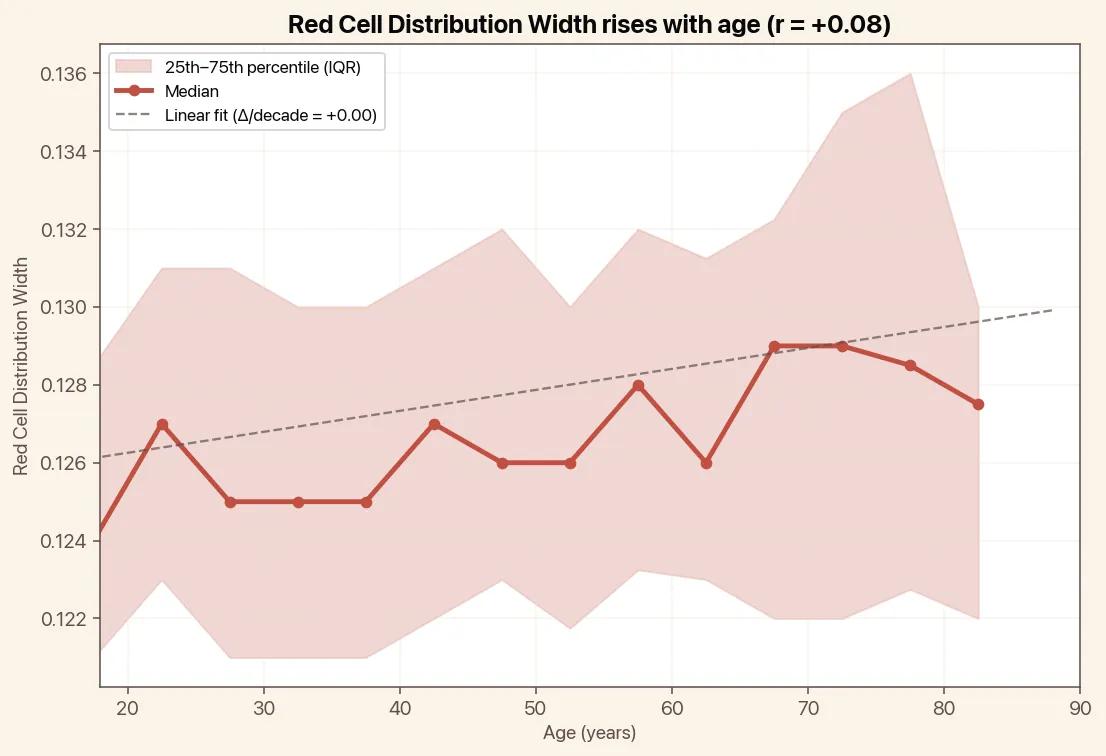
Red Cell Distribution Width tends to rise with age (correlation with age, r = +0.08). The chart below shows the median by 5-year age bin and a linear trend line.

Red Cell Distribution Width rises with age, chart with median and linear trend

What can cause high RDW?

A normal RDW is 11.5 – 14.5 %. Lower is better.

High RDW is most commonly caused by iron deficiency, B12 deficiency, or folate deficiency. Each produces red cells of different sizes as the body struggles to compensate. Recent blood transfusions or mixed nutritional deficiencies also raise RDW.

A high RDW with a normal MCV can be an early warning sign of developing nutritional deficiency before anemia appears on other markers. Chronic liver disease, chronic inflammatory conditions, and heart failure are other common causes.

Addressing the underlying nutritional deficiency (iron, B12, or folate supplementation) is the most effective way to normalize RDW. Because RDW is also linked to inflammation and cardiovascular risk, the usual heart-healthy lifestyle recommendations (regular exercise, healthy diet, not smoking) may help keep it in range long-term.

Biomarkers related to RDW

RDW is most highly correlated with Total Protein and LDL Cholesterol. Here are the top biomarkers correlated with RDW, based on 500,000 tests done by Empirical Health.

The percentage shows how strongly two biomarkers move together. A higher number means the relationship is stronger. Green = rises and falls together. Orange = one rises as the other falls.

Frequently asked questions about RDW

Where to get an RDW test near you

RDW is drawn at 2,200+ Quest and BioReference patient service centers across the US, so there's usually one within a short drive. Browse the full directory to find the one closest to you.

Browse all testing locations

Know your RDW. Know your health.

Test your Red Cell Distribution Width and 100+ other biomarkers in a single blood draw.

Image of a man on cellphone
Start testing